Lili Handel
/blood, poetry and music from thewhite whore's buduar/
physical performance
text, choreography and original music - Ivo Dimchev
The main incentive for creating this performance is the idea of the human body as a subject of physical and aesthetic consumption.
(premiere- House of Dance - Stokholm) 2004
Award for Best Actor by the International Jury of Young Critics - MASK theatre festival - Szeged /Hungary/ 2005
Nomination For Bessy Award for Lili Handel presented in La mama Theatre New York 2011
REVIEWS
"Ivo Dimchev's powerful solo exposes the body as a multi-expressive reality.
It reminds us that the body is not merely a form, to be perceived mainly visually, but
that it has a constitutive inside. Dimchev extends this
interiority to the audience by all means, voice,
movement, speech even his blood, and engages them
viscerally." Gurur Ertem
that it has a constitutive inside. Dimchev extends this
interiority to the audience by all means, voice,
movement, speech even his blood, and engages them
viscerally." Gurur Ertem
Lili Handel
An experienced theater audience can be moved by very simple things, irrespective of where they may live in the world. In this respect, critics and spectators are very much alike. After some performances they tend to both be experienced enough to acknowledge the cognitive, kinetic, visual and other patterns that constitute a theater production, not to mention directors' particular use of language as their "trademark".
Stage gestures, for instance, were thought of as an outrageous and scandallous innovation some decades ago, but are hardly used today. Some vanished from the theater stage altogether, whereas others reappeared a few years later and were then of course introduced as a "revolutionary" kind of novelty. Other gestures have become common inventory for both commercial and alternative theater productions. For that reason I have felt that mainstream Hungarian theater often tends to stagnate without daring to look ahead and evolve. The majority of performances at the 2005 Szeged Thealter Festival, for instance, failed to impress in ways similar to Ivo Dimchev's work and thus cannot breathe fresh life into Hungarian theater, particularly if only seen by a few hundred spectators.
Whether it seems a shame or not, I havent heard of the Bulgarian artist Ivo Dimchev before. According to his homepage, he is a kind of Gesamtknstler who composes music, acts in films and on stage, creates choreographies and dances, but he is also involved in photography and video. He arrived in Szeged with the performance of Lili Handel recently presented in Stockholm. There seems to be a subtitle that follows the theatre programme, which, actually, is a precise definition of genre: Blood, poetry and music from the white whore's boudoir. Much more than just a definition, it constitutes the essence of the whole performance, which cannot be expressed precisely by verbal means. You cannot hear a coherent text here, you can hardly hear words either, and you cannot read anywhere what kind of woman is hidden behind the female name in the title. Nonetheless Ivo Dimchev provides us with a detailed and accurate biography of her.
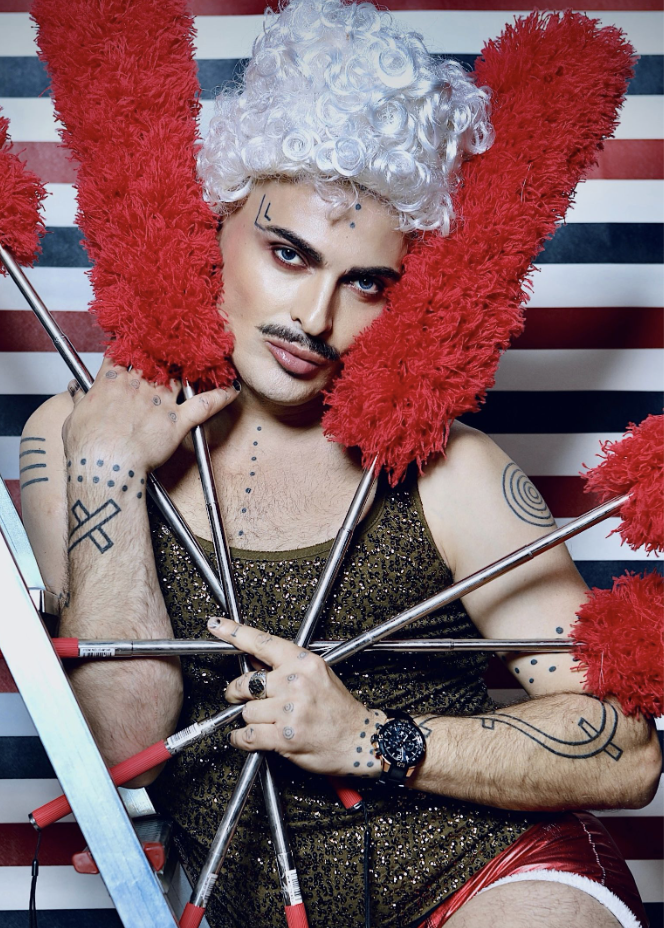
Lili Handel`s stage presence suggests that she may have been admired and maybe even lusted after by both men and women in her days of glory. She could have been the shining star of a varsity show with her special kind of aura. Her violently expressive beauty could have stirred a complex set of feelings in spectators somewhere between fear, admiration and desire. Yet now her glitz and glamour is over, and the glory of the goddess has ended. Her beauty has not just faded away, but she has instead turned into a faceless and sexless creature, a phantom by trying too hard to keep her former self alive. Although she has conserved her body in masterful shape, the course of the performance offers a glimpse into the dark secrets of her soul. She is unable to admit that her time is over, and thus she desperately tries to change her lonely life into a theatrical performance, in which she recreates symbols of her glory days out of ordinary actions and objects. She is willing to do anything to evoke a mixture of fear and respect, even now in the face of her decay. Lili Handel`s story forcefully exemplifies the human anxiety of time running out and our desperate attempt to slow down its passage. In Lili`s case however the effort is not in vain, as in the best scenes of the performance she manages to restore her former glory to such extent that the audience showers her with respect and adoration.
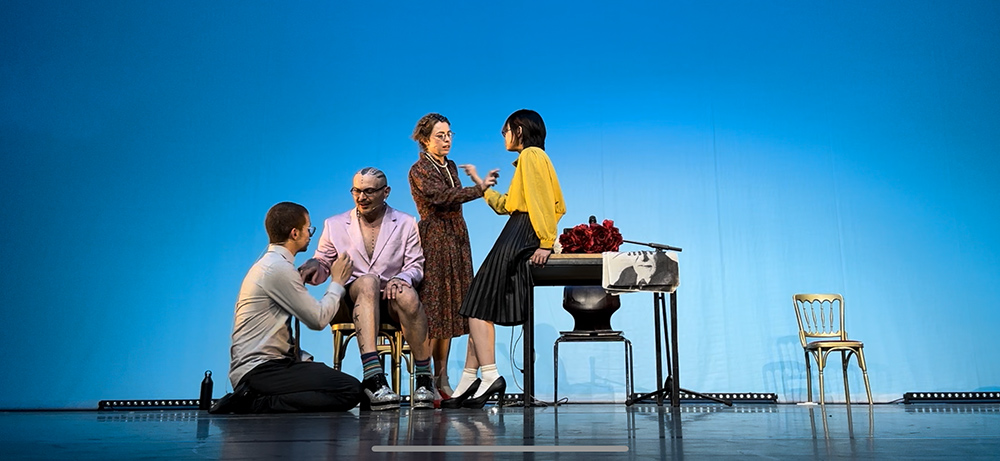
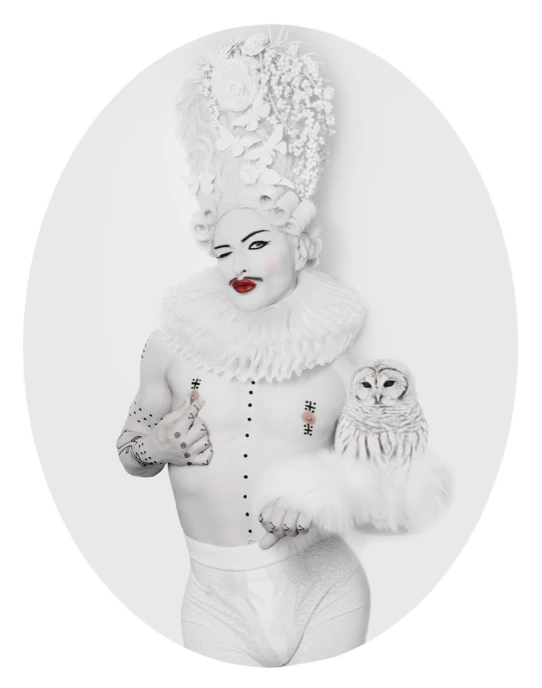
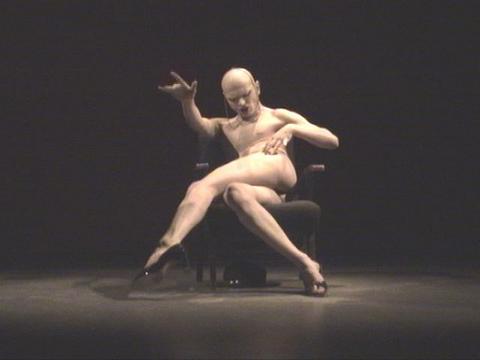
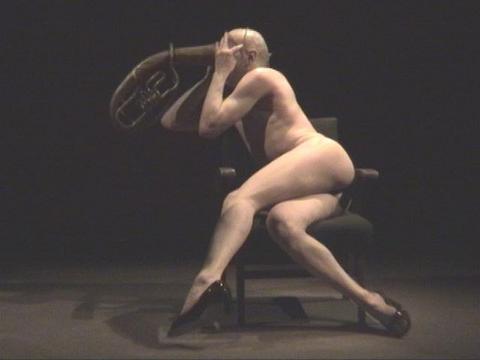
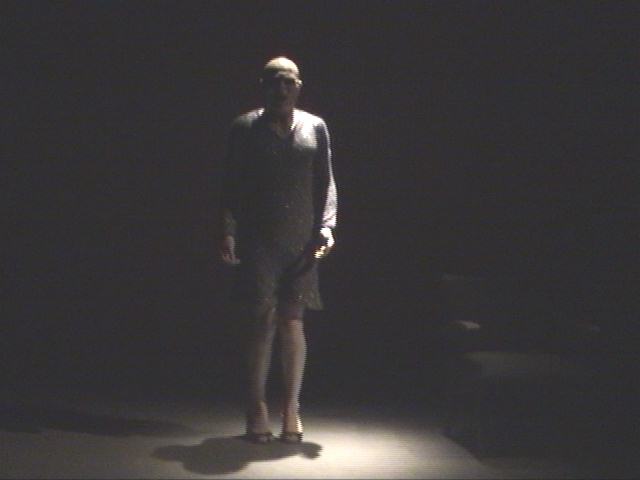
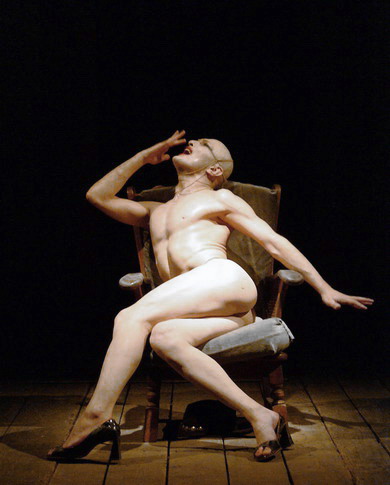
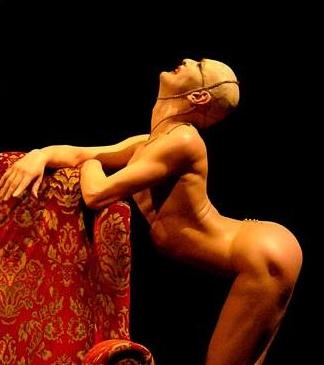
There are few occasions in which you can see characters portrayed with such radiating glory as in this piece by Ivo Dimchev. At the beginning the stage at the Old Synagogue is completely dark and empty except for an old armchair and a small red curtain reminiscent of the stage set-up in traditional theatre. The setting is complemented by all but a few additional props, which cannot be seen clearly but are only discerned vaguely by the spectators. As the light grows stronger, Lili Handel approaches the stage from the audience while singing ever louder with the high-pitched voice of a eunuch. You dont have to be a musician to notice right away that it is neither a woman nor a man singing. This uncertainty becomes reinforced by Lili Handel walking along the uneven surface of the Synagogue in her high-heeled shoes turning into a completely naked man at the end. Or is it a woman?
At this point words fail to express the true impact of the scene. The images presented in short sequences are too complex in nature to be described accurately by verbal means. And observing the audience`s reactions was a truly moving experience. We have seen many provocative performances before, but this one is of unprecedented magnitude. Incidently, the true essence of Dimchev`s art is illustrated by a set of a swear words uttered by a man in the audience who could only stand to see five minutes of the performance. These same words were then integrated by Dimchev into the production. Some in the audience may wonder whether this man was there on purpose or not. Yet this may not be the most important question with respect to Ivo Dimchev`s performance. It is simply impossible to remain indifferent since the complex movements of the naked and androgynous body as an artistic expression are forever burnt into your memory. We are presented with an alien creature whose face looks as artificial as a masque of porcelain, a musician whose only instrument is his own body. We are witnessing the tragic and final outcome of a body that is both naked and helpless. shows signs of emotional torture, yet is beautiful. No matter how you feel about the performance or try to categorize it, it calls for a strong reaction on behalf of the audience including discussion, individual or collective reflection and analysis that may last for weeks or months.
Ivo Dimchev goes even further when he shows us that any kind of art is a matter of life and death if you practice it seriously. He draws his own blood with the same caution as a doctor and then tries to sell it to the highest bidder something which the audience might find appalling. Lets pause for a while and reflect on the true meaning of this scene. Dimchev certainly puts his whole heart into his production. Why else would someone offer his own blood or other bodily fluids to his audience? In the golden age of genetics the fluid in the phial can be regarded as the perfect impression of the personality, as its bizarre core. It is not (only) the ungraspable soul but the remouldable body that is closed in the bottle. Or it might have another interpretation - during summer off season the news in brief on the newspapers' back page reports that Hollywood's actual celebrities put their personal belongings on auctions. Where is it different from what we can see on the stage of Dimchev? Although it is unpleasant to say, Lili Handel holds a mirror to all of us and confronts us with our darkest nightmares straightforwardly and with exceptional accuracy (remember the well-to-do man in his fifties who disappeared cursing and swearing). That is what we are (too), it is no use denying. In theory we are open and tolerant. And what if our inner monster is standing right in front of us? We are short of words but the feeling of unbearableness stays with us for long.

Tamas Jaszay


Tamas Jaszay (26), graduated from the University of Szeged, Hungary, in Hungarian language and literature, history, and comparative literature. Comparative literature PhD student between 2002 and 2005. His writings on theatre has been published by the second oldest theatrical journal since 2003. Publishes critics, essays, translations and interviews. He's been writing detailed reports of the Thealter Festival of Szeged for 3 years. The article is part of this year's report of the festival, where he participated as the assistant of the international critics' seminar as well.

----------------------------------------------------------------------------------------------------------------------------------------------

The body when free becomes itself. It reaches such a boundary, where only a constructive outside happening process could come to being. Ivo Dimchev, a talented representative of the contemporary Bulgarian dance art is a great master of this.
His deadly accurate, acute, unmistakable moves, combining the intentionally hesitating move-compositions with the piercing cold singing voice, make the recipient shiver. Dimchev completely takes his body to pieces, after that pretending to have lost control over it, extract the spirit and the established stereotype. Alone fills in the stage, only a chair and one red curtain make the scenery. The look of Dimchev`s body, which in this case could be accepted as a piece of art, arises strange feelings in the audience, as being a man who has completely weird body abilities, appears on stage as a fusion creature that packs up the man and the woman in one. Sometimes I had the feeling that I wasnt watching a human being moving on stage, singing strangely, or raving in extazis, wriggling, it was more like and appeared so, that there was life in other worlds too, and to prove this they had presented this weird, neither a woman, nor a man creature,